
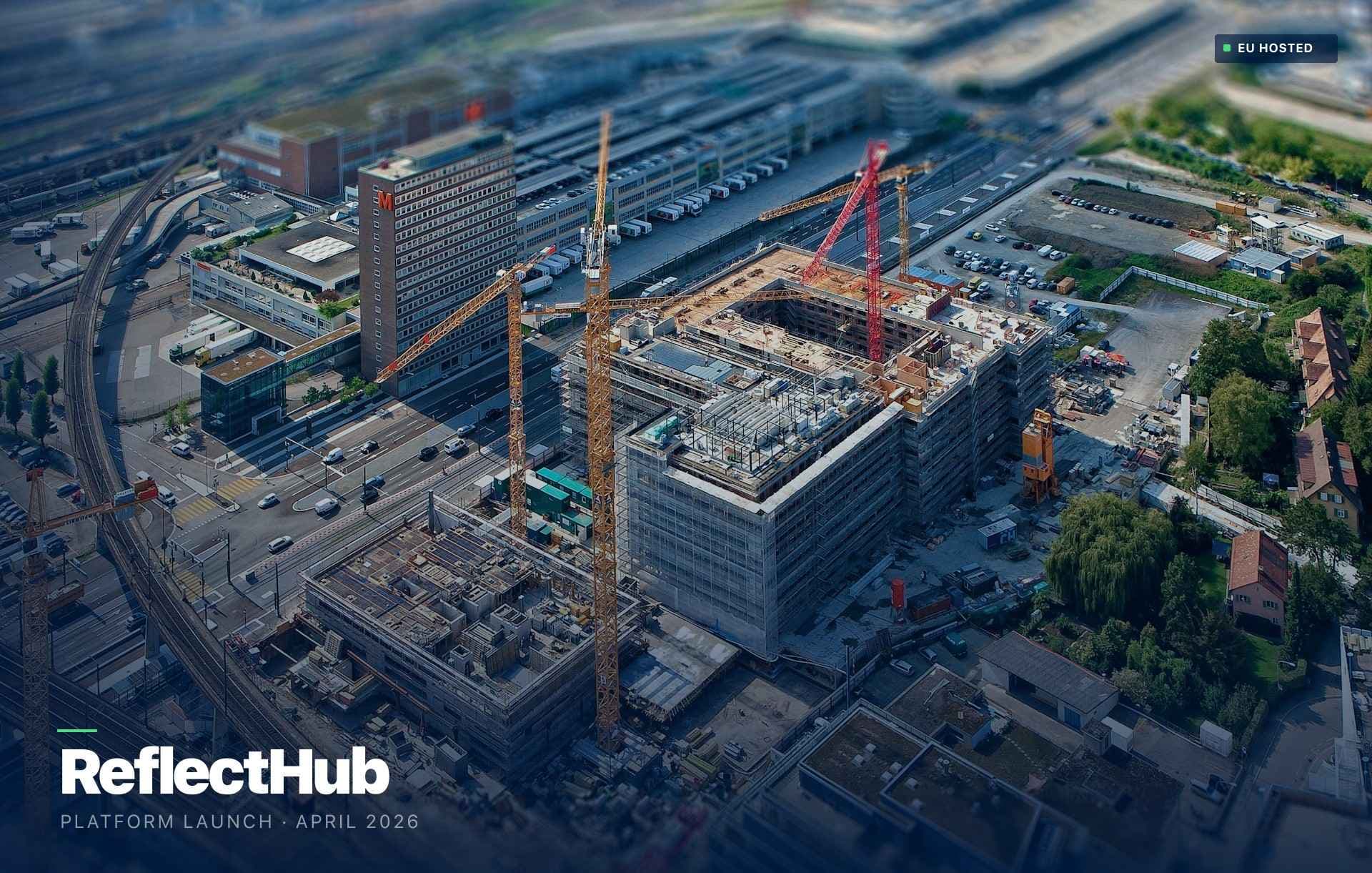
I did not move from construction into technology because I stopped caring about construction.
I moved because I cared too much to accept how much good work was still being slowed down by bad systems.
I studied construction because I was drawn to work that had weight to it. In construction, ideas do not stay theoretical for long. A decision becomes a drawing. A drawing becomes a plan. A plan becomes a deadline, a dependency, a cost, a conversation on site, and eventually something real that people can stand inside. I loved that honesty.
And when you spend time close to construction work, you also learn something else very quickly: projects rarely break down because people do not care. They break down because information does.
The Pattern That Stayed With Me
A lead comes in, but key details live in someone's inbox. An offer is prepared, but the same information has to be typed in again somewhere else. A project is won, but documents are scattered across folders, comments are buried in email threads, expenses are tracked in one place, time is logged in another, and team availability or certifications are often known best by the people who have been around the longest. Everyone is working hard, but not everyone is working from the same picture.
That pattern stayed with me.
So when I changed direction and moved deeper into IT, it did not feel like leaving construction behind. It felt like coming at the same problem from a different angle. For a long time, I had this very simple dream: to combine what construction had taught me about real work with what technology can make possible when systems are designed properly.
Not technology for the sake of technology.
Not another generic platform that looks impressive in a demo and then quietly creates even more admin in real life.
Something practical. Something grounded. Something built around the way construction companies actually move from first contact to finished work.
That is why we created ReflectHub.
What We Built — and Why
We created ReflectHub because the handover from enquiry to offer to active project should not feel like starting from zero every time. We created it because project delivery should not live across five different tools and ten different habits. We created it because documents should stay tied to the work they belong to. We created it because expenses, worklogs, skills, workload, qualifications and day-to-day coordination should be visible in one operational picture instead of being reconstructed from memory.
In other words, we created ReflectHub to help teams keep work moving.
What ReflectHub makes possible
Enquiry to active project
Turn enquiries into active projects without rebuilding information from scratch. Client context, scope, and budget transfer automatically — no reconstruction.
Full project visibility
Tasks, stages, timelines, documents, comments, expenses and worklogs — all tied to the project and visible in one place.
Team capacity and qualifications
See not only who is available, but what they are qualified to do and where workload is already sitting. Skills, certifications, and allocation in one view.
Repeatable operations
Templates, structured workflows, questionnaires and shared company data make operations more consistent and less dependent on individual memory.
This Is a Construction Story
For me, this is not just a software story. It is a construction story.
Construction has been slower than many industries to digitise, and the consequences are measurable. Industry bodies still describe it as heavily manual, while research keeps pointing to the same conclusion: stronger information management improves productivity and lowers cost, while bad data and disconnected communication create expensive rework and wasted effort.
That is exactly the gap I wanted to work on.
Because when information is fragmented, the damage is not always dramatic. Often it is quieter than that. A missed update. A duplicated task. A delayed approval. A cost that appears too late. A qualification check done manually. A team member who cannot find the right document fast enough. A project manager spending energy chasing clarity instead of driving progress.
Individually, those things look small.
Together, they shape how a company feels to work in.
Stage
Fragmented
Connected
Click a row to highlight
They affect pace, trust, accountability and confidence. They affect whether work feels manageable or constantly reactive. They affect whether growth feels exciting or chaotic.
Why Perspective Matters in the Tools We Build
As a woman working across both construction and technology, I have spent a lot of time in spaces where the default assumptions were shaped by people with very similar backgrounds. That matters more than people think. It affects what problems are considered "normal". It affects what friction gets ignored. It affects who is expected to do the invisible work of following up, translating context, remembering details and keeping things aligned.
19.5%
Women in ICT (EU)
Women make up 19.5% of ICT specialists across the EU — and an even smaller share of the construction workforce
~13%
Women in construction
Women remain a small minority of the construction workforce across Europe, leaving a significant perspective gap in the tools built for the industry
2x
Better outcomes
Research consistently links more gender-balanced digital teams to tools that are fairer, more inclusive, and better designed for real operational complexity
The reason I care about women in technology is not because it is a nice message to add at the end of a founder story. I care because perspective changes products. Across the EU, women make up just 19.5% of ICT specialists, while women in construction remain an even smaller share of the workforce. That representation gap matters not only for fairness, but because more gender-balanced digital teams are more likely to build better, fairer and more inclusive tools.
Building Something Genuinely Useful
So yes, ReflectHub is about construction. But it is also about translation.
It is about taking what I learned from one world and building something useful in another. It is about respecting the reality of how construction work actually happens, while refusing to accept that scattered information, duplicated admin and fragmented systems are just "part of the job".
They are not.
They are solvable.
ReflectHub is our attempt to solve them in a way that feels grounded, operational and human.
Because the best systems do not make work feel more complicated.
They make good work easier to see, easier to manage and easier to move forward.
And for me, that is what this has always been about: building something genuinely useful for an industry I never really left.
ReflectHub is a project management platform built specifically for construction and architecture firms. EU-hosted. GDPR-ready. Built for teams of 5–50.
Get started → — or book a demo for a guided walkthrough.